Essay: Girmitiyalogy at the Crossroads of Transcontinental Trajectory
WWW. Girmiyalogy.com.
Author: Dr. Shardhanand Harinandan Singh, Founder of the Interdisciplinary Study of Girmitiyalogy and Professor in Transcontinental Migration Studies, EIMT, Zürich, Switzerland. Copy © 2026 Harinandan Singh, Rotterdam. This essay presents a concise analytical overview of Girmitiyalogy at the request of Senior Professor Dr. Devendra K. Choubey, the Center of Indian Languages (CIL), School of Language, Literature and Culture Studies, Jawaharlal Nehru University, New Delhi, India, for internal communication.
Summary
Girmitiyalogy is an emerging interdisciplinary paradigm dedicated to the study of Indian indentured laborers and their descendants worldwide. The essay explores the philosophical foundations of the discipline, including historical justice, restoration of ancestral bonds, decolonization of knowledge, unity in diversity, Itihāsa-based knowledge production, and homogenization in multicultural societies. It further introduces the concepts of the Transcontinental Migration Crossroad and the Triadic Trajectory, distinguishing among the first migration of indentured laborers, the transformational settlement experiences of descendants, and subsequent secondary migration trajectories.
By Girmitiyalogy, particular attention is given to the concepts of identity formation, sustainable connectedness, digital archiving, genealogical reconstruction, and the preservation of tangible and intangible heritage. The essay argues that Girmitiyalogy provides an innovative framework for understanding the historical and contemporary realities of Global Girmitiya Communities while contributing to the decolonization of indenture studies and the restoration of marginalized historical voices. Through interdisciplinary scholarship, archival preservation, education, and international cooperation, Girmitiyalogy seeks to strengthen historical consciousness, cultural continuity, and intercultural understanding across continents.
सारांश
गिरमिटियालॉजी (Girmitiyalogy) एक उभरता हुआ अंतःविषयक (interdisciplinary) प्रतिमान है, जो विश्वभर में भारतीय गिरमिटिया श्रमिकों तथा उनके वंशजों के अध्ययन हेतु समर्पित है। यह निबंध इस अनुशासन की दार्शनिक आधारशिलाओं का विश्लेषण करता है, जिनमें ऐतिहासिक न्याय, पैतृक संबंधों की पुनर्स्थापना, ज्ञान का उपनिवेश-मुक्तिकरण (decolonization of knowledge), विविधता में एकता, इतिहास (Itihāsa) आधारित ज्ञान-निर्माण, तथा बहुसांस्कृतिक समाजों में समरूपीकरण (homogenization) जैसे सिद्धांत सम्मिलित हैं।
इसके अतिरिक्त, यह निबंध ट्रांसकॉन्टिनेंटल माइग्रेशन क्रॉसरोड (Transcontinental Migration Crossroad) तथा ट्रायाडिक ट्रैजेक्टरी (Triadic Trajectory) की अवधारणाओं को प्रस्तुत करता है। इनके माध्यम से तीन प्रमुख ऐतिहासिक प्रक्रियाओं को पृथक किया गया है: प्रथम, गिरमिटिया श्रमिकों का मूल प्रवासन; द्वितीय, उनके वंशजों के स्थायी बसाव एवं रूपांतरणकारी अनुभव; तथा तृतीय, पश्चातवर्ती द्वितीयक प्रवासन (secondary migration) की प्रक्रियाएँ।
गिरमिटियालॉजी विशेष रूप से पहचान-निर्माण (identity formation), सतत् संबद्धता (sustainable connectedness), डिजिटल अभिलेखीकरण (digital archiving), वंशावली पुनर्निर्माण (genealogical reconstruction), तथा मूर्त एवं अमूर्त सांस्कृतिक विरासत के संरक्षण पर बल देती है। यह निबंध प्रतिपादित करता है कि गिरमिटियालॉजी वैश्विक गिरमिटिया समुदायों की ऐतिहासिक एवं समकालीन वास्तविकताओं को समझने के लिए एक अभिनव वैचारिक ढाँचा प्रदान करती है। साथ ही, यह गिरमिट अध्ययन के उपनिवेश-मुक्तिकरण तथा इतिहास के हाशिए पर पड़े स्वरों की पुनर्स्थापना में महत्त्वपूर्ण योगदान देती है।
अंतःविषयक शोध, अभिलेखीय संरक्षण, शिक्षा तथा अंतरराष्ट्रीय सहयोग के माध्यम से गिरमिटियालॉजी का उद्देश्य ऐतिहासिक चेतना, सांस्कृतिक निरंतरता तथा महाद्वीपों के बीच अंतरसांस्कृतिक समझ को सुदृढ़ करना है।
Abstract
The formal inauguration of the Indian indentured labor system on 10 September 1834 marked a new phase in Western European colonial expansion following the abolition of slavery. A central question remains whether this transcontinental labor migration constituted a form of free migration or continued colonial labor regimes under contractual bondage.
Girmitiyalogy advances the position that indenture was, in a legal sense, fundamentally a system of unfree and bonded labor. Once laborers had signed their contracts, withdrawal from the migration process was generally impossible except under conditions prescribed by the rules.
Of particular historical significance is the emergence of the terms Girmit and Girmitiya in the West Bengal port city of Calcutta on the eve of the first departures. These terms were not created by colonial administrators or later scholars but by the Indian indentured emigrants themselves. As many recruits were unfamiliar with English, they adapted the word agreement into Girmit and collectively identified themselves as Girmitiyas. This linguistic innovation reflected both their encounter with the colonial contract system and the formation of a shared migrant identity. However, the indenture system was known by different names across the colonial world, including kantrakis in the Dutch colony, engagés in the French colonies, and jahaji bhai/bahin or kalkathiyas among the migrants themselves.
The term Girmitiyalogy derives from this historical legacy. It has been adopted as an interdisciplinary paradigm for the study of Indian indentured laborers and their descendants worldwide, encompassing historical, cultural, social, genealogical, and contemporary dimensions of the Girmitiya experience. By centering concepts generated by migrants themselves, Girmitiyalogy acknowledges their historical agency and lived experiences while contributing to the decolonization of knowledge production in indenture studies. It is important to emphasize that the paradigm Girmitiyalogy was formally adopted at Lucknow University on 30 May 2025 as a stipulated working definition intended to guide global academic applications.
This essay presents a concise analytical overview of Girmitiyalogy as an emerging scholarly paradigm and examines its relevance within contemporary international academic discourse.
In particular, a number of capita selecta constituting the broader Materia Girmitiyalogica have been delineated and placed within the framework of contemporary scholarly inquiry.
Keywords: Girmitiyalogy Philosophy; Transcontinental Migration; Triadic trajectory crossroad, Post-Indentured Identity, Restorative Recognition, Girmitiya diaspora; Trias Pora; first migration; secondary migration; twice migration; re-routing; transformed identity; cultural memory; displacement; resettlement; belonging; multiculturality; homogeneity, itihāsa.
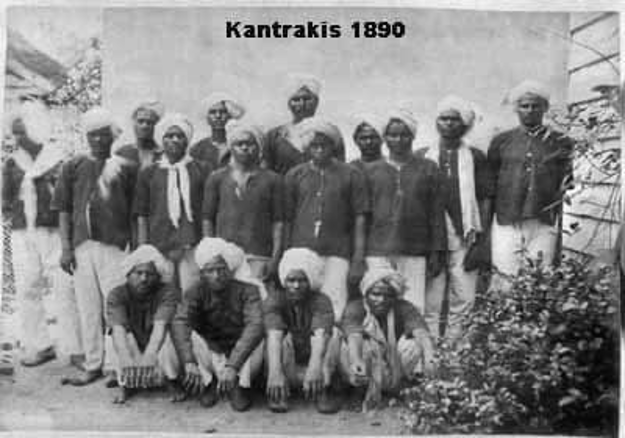
Indian Indentured of the first migration trajectory. Source: https://www.researchgate.net/figure/a-First-generation-of-Indian-indentured-laborers-in-Suriname-c-1900-the-forefathers_fig5_355389415?utm_source=chatgpt.com
1 Philosophy of Girmitiyalogy as a Scientific Discipline
Girmitiyalogy was conceptualized on 30 May 2025 following the author’s critical reflection on a fifteen-day seminar on the digitization of Girmitiya archives held at Lucknow University, India. As an interdisciplinary field of inquiry, it encompasses the historical, contemporary, and future dimensions of the global Girmitiya diaspora through research, documentation, education, and digital preservation. Why should Girmitiyalogy exist and be unique in this domain?
The philosophy of a scientific discipline concerns the fundamental questions upon which that discipline is founded: what is studied, why it is studied, how knowledge is produced, and which values guide scholarly inquiry. Within this framework, Girmitiyalogy may be understood as an emerging interdisciplinary paradigm dedicated to the study of the histories, experiences, cultures, identities, migration trajectories, and contemporary realities of Girmitiyas (Indian indentured laborers) and their descendants worldwide.[1] The philosophical foundations rest on the following premises.
a. Historical Justice. Girmitiyalogy seeks to contribute to historical justice by recovering, documenting, and critically examining the experiences of indentured laborers whose voices have often been marginalized in colonial historiography.[2] The discipline encourages the inclusion of subaltern perspectives, oral histories, family archives, and community memories alongside official colonial records.
b. Restoration of Ancestral Bonds. A central philosophical objective of Girmitiyalogy is the restoration of ancestral connections between descendants of indentured migrants and their places of origin.[3] Through genealogical research, archival reconstruction, and digital heritage initiatives, the discipline aims to reconnect fragmented family histories disrupted by colonial labor migration.
c. Decolonization of Knowledge. Girmitiyalogy promotes the decolonization of knowledge by critically reassessing Eurocentric interpretations of indenture and incorporating perspectives generated by Girmitiya communities themselves.[4] It recognizes that historical understanding should emerge from multiple knowledge systems, including indigenous, diasporic, and community-based sources.
d. Unity in Diversity. The discipline examines how Girmitiya communities preserved cultural continuity while simultaneously adapting to new multicultural environments.[5] In this regard, Girmitiyalogy resonates with the ancient Indian philosophical principle of Vasudhaiva Kutumbakam (“The World is One Family”), emphasizing coexistence, mutual respect, and shared humanity.[6]
e. Itihāsa as normative Principle. Girmitiyalogy develops knowledge through the guiding principles of Itihāsa, valuing historical memory, lived experience, and the voices of Girmitiya communities. Its publications are informed by these traditions while adhering to the standards of modern scientific scholarship, including critical inquiry, methodological rigor, source transparency, and academic integrity. The discipline thus seeks to bridge Itihāsa-based knowledge and contemporary science in the study of the global Girmitiya experience.[7]
f. Homogenization in a multicultural society. Girmitiyalogy recognizes that sustainable social cohesion in multicultural societies is best achieved through the homogenization of shared civic values, mutual respect, and collective responsibility, while preserving the cultural, linguistic, and religious diversity of communities.
Within the Girmitiyalogy paradigm, descendants of Girmitiyas – the Girmitiya diaspora – are encouraged to maintain their ancestral heritage while contributing to the development of an inclusive and interconnected society. [8]
Footnotes
[1] Scientific Discipline – A structured field of inquiry characterized by a distinct object of study, theoretical framework, methodology, and body of knowledge.
[2] Historical Justice – The scholarly and ethical effort to recover, acknowledge, and critically examine historically marginalized or silenced experiences in order to achieve a more balanced understanding of the past.
[3] Ancestral Bonds – Genealogical, cultural, historical, and emotional connections linking individuals and communities to their ancestral origins.
[4] Decolonization of Knowledge – A process of critically reassessing colonial epistemologies and incorporating alternative perspectives, particularly those originating from formerly colonized peoples and communities.
[5] Unity in Diversity – A social and philosophical principle asserting that social cohesion can coexist with cultural, linguistic, ethnic, and religious diversity.
[6] Vasudhaiva Kutumbakam – A Sanskrit philosophical concept meaning “The World is One Family,” originating in the Mahā Upanishad, emphasizing universal kinship and human solidarity.
[7] Itihāsa – A Sanskrit term commonly translated as “thus indeed it happened,” referring to historically grounded narratives that preserve collective memory, moral reflection, and cultural knowledge while serving as a source of understanding about the past.
[8] Homogenization in a Multicultural Society – A normative principle that holds that sustainable cohesion in multicultural societies emerges through shared civic values and collective responsibility rather than cultural assimilation, allowing diverse communities to retain their distinct identities while participating in a common social framework.
2 Transcontinental Migration
In the scholarly literature, the concept of transnational migration is commonly used to describe the movement of individuals and communities from one nation-state to another while maintaining social, economic, cultural, or political ties across national borders. However, in response to increasingly globalized and multidirectional migration processes, Girmitiyalogy adopts the broader concept of the Transcontinental Migration Trajectories.
The concept of transcontinental migration trajectories refers to the multidimensional interplay among migration trajectories, cultural exchanges, identity formation, and historical processes that emerge as individuals, families, and communities move across continents and establish new social, cultural, and economic roots. Within Girmitiyalogy, this concept is particularly relevant to the experiences of Indian indentured laborers and their descendants, whose histories unfolded through successive movements linking Asia, Africa, the Caribbean, the Pacific, Europe, and North America.’
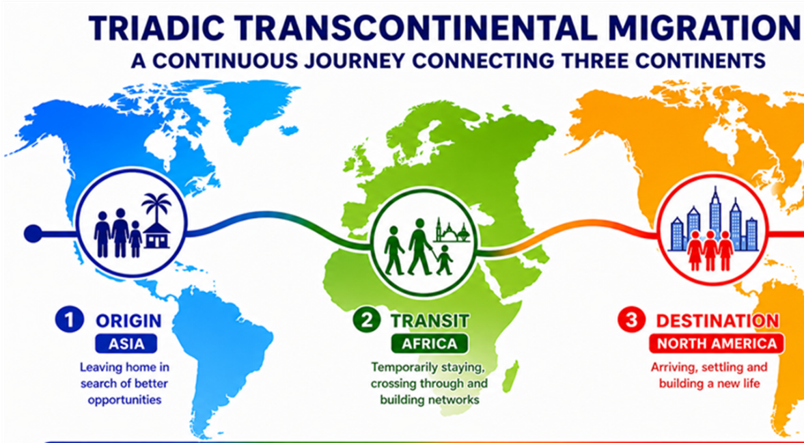
Image: ChatGPT May 10, 2026, © 2026 Harinandan Singh, Rotterdam.
However, unlike conventional transnational migration theory, which primarily focuses on relations between nation-states, the concept of the Transcontinental Migration Crossroad emphasizes long-term civilizational connections, diasporic continuities, ancestral reconnections, and multiple migration trajectories across continents. It therefore provides a broader analytical framework for understanding the historical and contemporary mobility of Girmitiya communities and the emergence of complex identities shaped by successive waves of migration. The concept further recognizes that migration is rarely a single event. Rather, it often involves multiple stages of relocation and re-rooting, producing what Girmitiyalogy identifies as secondary, tertiary, and even diasporic migration trajectories.
In contemporary scholarship, the concept contributes to broader discussions in migration studies, diaspora studies, transnationalism, cultural anthropology, and digital humanities by emphasizing the interconnected nature of human mobility across continents and generations.[9]
3 Triadic Trajectory in Transcontinental Migration crossroad
Girmitiyalogy recognizes a triadic trajectory situated at the crossroads of transcontinental migration waves. This framework seeks to explain the historical, contemporary, and future-oriented dimensions of the global Girmitiya experience.[10]
a. The First Migration Trajectory
The first trajectory concerns the migration of more than 1.3 million Indian indentured laborers who were transported between 1834 and 1920 from India to colonies across Asia, Africa, the Caribbean, the Pacific, and South America.[11] While approximately one-third of these migrants are believed to have repatriated to India after completing their contracts, comprehensive archival data regarding return migration remains incomplete.[12] Within Girmitiyalogy, the processes of displacement, relocation, adaptation, and settlement constitute important fields of scholarly inquiry, archival reconstruction, historical reinterpretation, and digital preservation.[13]
b. The Second Trajectory: Transformation and Settlement
The second trajectory concerns the transformational processes experienced by Girmitiyas and their descendants, both historically and in contemporary societies, as they sought to establish dignified and sustainable lives either upon repatriation or through permanent settlement in their adopted homelands.[14] In both contexts, significant challenges and opportunities can be identified. This trajectory constitutes a largely underexplored field for interdisciplinary research.
Girmitiya identity reconceptualizes as a dynamic, transformational field shaped by memory, heritage, mourning, resilience, adaptation, and future-oriented meaning-making, rather than as a residual outcome of colonial labor migration.[14] Indian indenture is therefore understood not merely as an archive of displacement but also as an ongoing ethical inquiry into recognition, belonging, identity formation, and intergenerational continuity.[15]
c. The Third Migration Trajectory: Secondary Migration and the Girmitiya Diaspora
The third trajectory remains insufficiently documented in existing scholarship. It concerns descendants of the first migration trajectory who subsequently migrated to and settled in Western-oriented societies for extended periods or permanently, including Europe, North America, Australia, and New Zealand.[16]
Girmitiyalogy identifies the third trajectory on the transcontinental crossroad as the category of Secondary Migration.[17] This group was rooted in the first migration trajectory with a number of 1.3-1.5 million Girmitiyas. Preliminary estimates suggest that in 2025, the number of the secondary migration category had become comparable to the number of people who migrated from India to the colonies between 1834 and 1920.[18]
Situated at the intersection of diaspora studies and decolonial historiography, Girmitiyalogy conceptualizes social cohesion as a form of sustainable connectedness extending beyond national boundaries.[19] This perspective is framed as a historically grounded process of restorative remembrance—commemorative and reparative rather than celebratory. The analytical framework focuses on three interrelated dimensions: the recovery of historical memory through archival and oral sources, the preservation of tangible and intangible heritage, and the activation of family archives and Itihāsa (bio-narratives) as sites of identity formation and cultural continuity.[20]
Finally, Girmitiyalogy introduces the concept of Twice Migration to describe transcontinental or transnational movements undertaken by individuals or groups who migrate from one country to another in search of improved social, economic, cultural, or political opportunities.[21] Such movements were already observable during the colonial period when former indentured laborers relocated from one colony to another—for example, from British Guiana to Suriname, from Mauritius to South Africa, or from Fiji to Australia and New Zealand.[22]
The concept of Twice Migration expands conventional migration theory by emphasizing successive migratory trajectories and the formation of multilayered identities across generations and continents. It therefore serves as an important analytical category within Girmitiyalogy for understanding the evolving experiences of the global Girmitiya diaspora.[23]
Footnotes
[9] Transcontinental Migration is a Girmitiyalogical perspective, yet it has not existed in the indentured encyclopedia. The Transcontinental Crossroad serves as a framework for understanding how migrant communities negotiate continuity and change while maintaining connections with ancestral homelands and adapting their loyalties to multiple nations in new, displaced sociocultural environments. It highlights the interplay between heritage preservation, cultural hybridization, identity reconstruction, and transnational citizenship.
[10] Triadic Trajectory – A Girmitiyalogical framework distinguishing three major migration trajectories: indentured migration, post-indenture transformation and settlement, and secondary migration of descendants across continents.
[11] Indian Indentured Labor Migration – The global labor migration system that transported more than 1.3 million Indians to colonial plantations following the abolition of slavery, between 1834 and 1920.
[12] Repatriation – The return of former indentured laborers and their descendants to their ancestral homeland after the completion of contractual obligations.
[13] Archival Reconstruction – The scholarly recovery, reinterpretation, digitization, and preservation of historical records relating to Girmitiya communities.
[14] Transformational Settlement Processes – The social, economic, cultural, and psychological adaptations through which migrants establish sustainable lives in new societies.
[15] Girmitiya Identity Formation – A dynamic process through which descendants of indentured laborers negotiate memory, heritage, belonging, resilience, and contemporary identities.
[16] Intergenerational Belonging – The transmission of identity, memory, values, and cultural continuity across successive generations.
[17] Secondary Migration – The movement of descendants of indentured laborers from their original post-indenture societies to new countries and continents.
[18] Secondary Migration Category – A Girmitiyalogical classification referring to descendants of the first indenture migration who subsequently migrated and resettled elsewhere.
[19] Global Girmitiya Diaspora – The worldwide population of descendants of Indian indentured labourers, including those residing in both original settlement societies and secondary migration destinations.
[20] Sustainable Connectedness – Long-term social cohesion maintained through cultural continuity, shared heritage, family networks, and transnational relationships.
[21] Itihāsa (Bio-Narratives) – Historically grounded personal, family, and community narratives that preserve memory and contribute to identity formation.
[22] Twice Migration – A Girmitiyalogical concept describing a second major migration undertaken by descendants of earlier migrant populations.
[23] Intercolonial Migration – Migration between colonies or former colonies, particularly among indentured laborers and their descendants seeking improved opportunities.
4 Vision and Mission of Girmitiyalogy
Vision. Girmitiyalogy envisions a world in which the histories, memories, identities, and contemporary realities of Indian indentured laborers and their descendants are recognized as integral to global human history. It seeks to establish a comprehensive interdisciplinary framework for studying, preserving, interpreting, and disseminating knowledge concerning the experiences of Girmitiyas across continents.[24] By promoting scholarly inquiry, digital archiving, and transnational collaboration, Girmitiyalogy aspires to contribute to the decolonization of historical knowledge and the restoration of ancestral bonds disrupted by colonial systems of labor migration.[25]
The paradigm further opted for the creation of a global intellectual and cultural network that connects descendants of indentured laborers with scholars, educators, archivists, policymakers, and community organizations. Through this process, Girmitiyalogy seeks to transform fragmented colonial records into accessible knowledge systems that strengthen historical consciousness, cultural continuity, and intercultural understanding.[26]
Mission
The mission of Girmitiyalogy is to advance the systematic study, research, documentation, digitization, interpretation, and dissemination of knowledge concerning Indian indentured laborers and their descendants worldwide.[27] The collection, analysis, and reformulation of acquired data—Materia Girmitiyalogica—serve as foundational resources for the development of the discipline. As an interdisciplinary paradigm, Girmitiyalogy integrates insights from History, Sociology, Anthropology, Migration Studies, Diaspora Studies, Psychology, Cultural Studies, Genealogy, Digital Humanities, and related fields.[28]
A central objective is the identification, preservation, and critical analysis of both tangible and intangible heritage associated with the Girmitiya experience, including archival records, oral histories, cultural traditions, genealogies, languages, literature, religious practices, and collective memories.[29] Particular emphasis is placed on reconstructing ancestral connections between India and the global Girmitiya diaspora through innovative archival, genealogical, and digital methodologies.[30]
Girmitiyalogy further promotes educational and scholarly development through academic curricula, research programs, conferences, publications, and digital repositories dedicated to the study of indenture and its global legacies.[31] In addition to historical inquiry, the field addresses contemporary issues affecting descendant communities, including identity formation, cultural resilience, migration, social mobility, and transnational belonging.[32]
Guided by the principle of Vasudhaiva Kutumbakam—One Earth, One Family, One Future—Girmitiyalogy seeks to contribute to both scholarly advancement and societal well-being while honoring the resilience, agency, and contributions of the Global Girmitiya Community to world civilization.[33]
The Global Girmitiya Communities constitute a distinct category within the broader Indian diaspora.[36] Unlike many contemporary diaspora groups, they emerged through the historical processes of indenture, settlement, and nation-building in diverse regions of the world. As a result, they possess their own national identities and citizenships in the countries where they and their ancestors established permanent homes.[34] Consequently, they should not be regarded as overseas Indians in a legal or political sense, but rather as citizens of their respective nations with unique historical experiences and cultural trajectories.[35]
The mission of Girmitiyalogy is therefore twofold. First, it seeks to promote respect for the national identities, civic loyalties, and cultural contributions of Global Girmitiya Communities within their respective societies.[36] Second, it aims to preserve and strengthen awareness of their genealogical, historical, cultural, and civilizational connections with India, from which their ancestors originated.[37] These ancestral bonds are not understood as claims to nationality but as enduring links to a shared heritage that has significantly shaped Girmitiya identities across generations.[38]
Through research, education, digital archiving, genealogy, and intercultural dialogue, Girmitiyalogy aspires to foster a deeper understanding of the global Girmitiya experience and to contribute to sustainable connections between peoples, cultures, and nations.[39] In doing so, it promotes the recognition of the Global Girmitiya Communities as an important historical and cultural bridge between India and the wider world.[40]
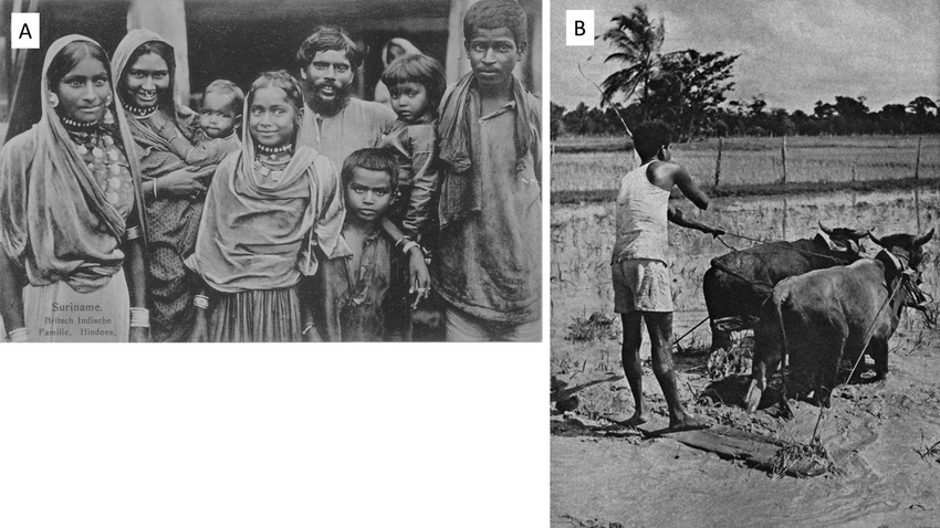
Descendants of the First migration trajectory. Source: Museum of World Cultures (1900-A296-51); b Hindustani farmer leveling a rice field with two bullocks, Suriname (1905). Picture: University of Amsterdam special collections (URI01-2792H39PL122)
Footnotes
[24] Refers to the vision of Girmitiyalogy as an interdisciplinary framework dedicated to the study, preservation, interpretation, and dissemination of knowledge about Indian indentured laborers and their descendants worldwide.
[25] The concept of decolonization is used here to denote the critical re-examination of colonial archives, narratives, and knowledge systems in order to restore marginalized historical perspectives and ancestral connections disrupted by colonial labor systems.
[26] Transnational collaboration includes cooperation among universities, archives, scholars, community organizations, genealogists, and descendant communities located across different countries and continents.
[27] Systematic study encompasses research, documentation, analysis, preservation, digitization, publication, and dissemination of knowledge relating to the historical and contemporary realities of Girmitiya communities worldwide.
[28] Girmitiyalogy adopts an interdisciplinary approach by integrating theories and methodologies from the humanities, social sciences, migration studies, digital scholarship, and heritage studies.
[29] Tangible heritage includes archival records, documents, artifacts, monuments, and historical sites, while intangible heritage includes languages, oral traditions, customs, beliefs, rituals, cultural practices, and collective memory.
[30] Genealogical reconstruction involves archival research, oral history, immigration records, digital databases, and family-history methodologies designed to reconnect descendants with their ancestral origins in India.
[31] Educational development includes the creation of academic curricula, degree programs, research centers, conferences, seminars, scholarly publications, and digital repositories dedicated to the study of indenture and its global legacies.
[32] Contemporary issues include identity formation, cultural resilience, migration experiences, social mobility, transnational belonging, intercultural relations, and the challenges of globalization among descendant communities.
[33] Vasudhaiva Kutumbakam is a Sanskrit expression originating in the Maha Upanishad and commonly translated as “One Earth, One Family, One Future,” emphasizing the unity of humanity beyond geographical, cultural, and political boundaries.
[34] Following settlement after indenture, descendants of Girmitiyas became citizens of independent nation-states such as Suriname, Guyana, Trinidad and Tobago, Mauritius, Fiji, South Africa, and other countries where their ancestors established permanent homes.
[35] The concept of Global Girmitiya Communities emphasizes shared historical origins and cultural heritage rather than legal nationality, political affiliation, or citizenship ties with India.
[36] The Global Girmitiya Communities constitute a distinct category within the wider Indian diaspora because of their shared historical experience of indenture, plantation life, adaptation, settlement, and participation in nation-building.
[37] Ancestral connections refer to genealogical, cultural, linguistic, religious, historical, and civilizational ties linking descendant communities to the regions of the Indian subcontinent from which their ancestors emigrated.
[38] These connections are understood as cultural and civilizational bonds rather than claims to Indian nationality, citizenship, or political allegiance.
[39] Research, education, digital archiving, genealogy, and intercultural dialogue constitute the principal instruments through which Girmitiyalogy seeks to achieve its scholarly and societal objectives.
[40] The Global Girmitiya Communities may be regarded as an important historical and cultural bridge connecting India with societies across the Caribbean, South America, Africa, the Pacific, Europe, and North America.
5 Terminologia Girmitiyalogica
Girmitiyalogy as a new paradigm uses terms that are most in line with its innovative mission. Here, methodology refers to the systematic research framework that outlines the overall. Some of the terms existed, while others are defined by the author’s self-approach. Together with the methods of data collection and analysis, it aims to examine and explain how Girmitiyalogy, as an emerging academic paradigm, engages with and addresses the central research question in a reliable, coherent, and academically rigorous manner. The following terms have been introduced and are now in circulation in scholars’ publications.
Girmitiyalogy
Girmitiyalogy, formally articulated on 30 May 2025, approaches the past, present, and future of the descendants of Indian indentured laborers as historically distinct and globally recognized ethnic communities within the broader Indian diaspora. Although these communities do not hold Indian nationality, they remain connected to Indian civilization in multiple historical, cultural, linguistic, and civilizational respects. [41]
Girmitiya diasporic communities
The historical trajectory differs significantly from that of other Indian diaspora communities, as they were displaced through systems of indenture under colonial rule and, over successive generations, developed new collective identities beyond India’s territorial boundaries.[42]
Within both academic and public discourse, the broader term Indian diaspora is increasingly complemented—and in some contexts gradually replaced—by the more historically specific concept of Girmitiya diaspora communities, while acknowledging important national and regional variations across different societies. Crucially, they are not formally Indians. Actually, it should be “Girmitiya descendant communities,” but the term “diaspora” leaves room for those who see remigration to the land of birth or ancestral villages as an option.
Nation-related identity (Naturallity)
While the collective identity of the descendants of indentured laborers evolved from an imposed colonial labor category into a self-defined Girmitiya collective consciousness—rooted in ancestral India and shaped within plantation societies—it was simultaneously reconfigured through nation-building processes and continuously rearticulated across transnational spaces. This historical transformation generated regionally specific forms of group identification among descendants of indentured laborers. In Suriname, descendants gradually came to identify themselves as Hindustanis or Surinamese Hindustanis; in Guyana, as Indo-Guyanese; in Trinidad and Tobago, as Indo-Trinidadians; in Mauritius, as Indo-Mauritians; and in Fiji, as Girmitiyas or Indo-Fijians. These self-designations reflect both processes of local adaptation within distinct national contexts and a shared inherited memory of displacement from India during the nineteenth and early twentieth centuries.[43]
Itihāsa
In this sense, Girmitiyalogy does not interpret the history of indenture merely as a colonial archive of labor migration, but as living narrative (Itihāsa): a continuing historical consciousness linking memory, displacement, identity formation, resilience, and moral continuity across generations. The Girmitiya diaspora is therefore understood not simply as a legacy of colonial labor, but as a transnational community whose identity continues to evolve through scholarship, digital archiving, intercultural dialogue, and renewed ancestral reconnection with India. Ranjan Ghosh conceptualizes Itihāsa as a distinct epistemological and historiographical framework through which India interprets the past beyond conventional Western linear historiography. [44]
This collection is tentative and intended as an illustration of the collection of more Terminologia Girmitiyalogica in the coming years.
Footnotes / Explanatory Notes
[41] Girmitiyalogy was formally coined and articulated following academic reflection on the Digitization of Girmitiya Archives Masterclass held at Lucknow University from 15–30 May 2025. Designed and led by the author at the invitation of the Department of English and Modern European Languages, the program brought together scholars and archivists to examine the preservation and accessibility of Girmitiya archives. The discussions revealed the need for a distinct interdisciplinary framework integrating archival studies, genealogy, migration history, diaspora studies, and digital humanities. In response, Girmitiyalogy was developed as a scholarly paradigm dedicated to the systematic study of Indian indentured laborers and their descendants worldwide. Its emergence is documented in institutional records and academic announcements issued by Lucknow University and collaborating partners.
[42] See William Safran on diaspora identity and homeland consciousness, and Steven Vertovec on diasporic networks and transnational belonging.
[43] Comparative demographic and historical studies confirm the emergence of region-specific Indo-diasporic identities in Suriname, Guyana, Trinidad, Mauritius, and Fiji.
[44] The use of Itihāsa here follows the Indic historiographical understanding of history as memory and moral continuity across generations.
In Conclusion
Girmitiyalogy emerges as an evolving interdisciplinary paradigm dedicated to the study, preservation, interpretation, and dissemination of knowledge concerning Indian indentured laborers and their descendants worldwide. Rooted in the historical experiences of more than 1.3 million migrants who crossed oceans, Kalapani, under the indenture system between 1834 and 1920, the paradigm seeks to transcend conventional approaches that have often confined indenture studies to colonial labor history alone.
The discipline argues that the historical experiences of Girmitiyas cannot be adequately understood through a single disciplinary lens. Rather, they require an integrated framework that combines history, genealogy, sociology, anthropology, migration studies, diaspora studies, psychology, cultural studies, digital humanities, oral history, and archival sciences. Through such an interdisciplinary approach, Girmitiyalogy seeks to illuminate the complex processes of displacement, adaptation, settlement, identity formation, memory preservation, and transcontinental mobility that have shaped the Global Girmitiya Communities.
A distinctive contribution of Girmitiyalogy is its recognition of the concepts Girmit and Girmitiya as historical terms created by the Indian emigrants themselves. By adopting terminology that originated within the lived experiences of indentured laborers, the paradigm acknowledges their historical agency and cultural resilience. In doing so, it contributes to broader efforts to decolonize knowledge production and restore marginalized voices within global historiography.
The essay has further proposed several conceptual innovations, including the notions of Transcontinental Migration Crossroad, Triadic Trajectory, Secondary Migration, Twice Migration, Sustainable Connectedness, and Itihāsa-based knowledge production. Together, these concepts provide analytical tools for understanding the historical and contemporary realities of descendant communities across the continents of Asia, Africa, the Caribbean, South America, Europe, North America, Australia, and the Pacific. By this, Indian heritage is found globally.
At its normative core, Girmitiyalogy seeks not only to advance academic knowledge but also to contribute to historical justice, ancestral reconnection, cultural continuity, and sustainable social cohesion. Through archival reconstruction, genealogical research, digital preservation, education, and intercultural dialogue, the paradigm aspires to strengthen awareness of a shared historical experience while respecting the national identities and citizenships of contemporary descendant communities.
Ultimately, Girmitiyalogy may be understood as both a scholarly endeavor and a societal project. It seeks to transform fragmented colonial records into living knowledge systems that foster understanding, recognition, and sustainable connectedness among peoples, cultures, and nations. Guided by the principle of Vasudhaiva Kutumbakam—One Earth, One Family, One Future—it contributes to a more inclusive understanding of global human history and the enduring legacy of the Global Girmitiya Communities.
Recommendations
International Recognition of Indenture History as a legacy by UNESCO
Universities, research institutes, museums, and governments should promote greater recognition of the historical significance of Indian indentured labor migration as an important chapter in world history.
Global Digitization of Archives, more than what is being done in 2025 by the Indian Government.
A coordinated international effort should be undertaken to digitize and preserve archival collections relating to indentured labor migration and descendant communities.
Development of Academic Programs to transfer in educational and policy applications
Universities should encourage the establishment of certificate, undergraduate, postgraduate, and doctoral programs in Girmitiyalogy and related fields.
Expansion of Genealogical Research by scholars from the Global Girmitiya Community.
Providing special Chairs for Professors in all nations with Girmitiya diaspora Citizens.
Special attention should be devoted to genealogical reconstruction projects enabling descendants to reconnect with ancestral villages, family histories, and migration records.
Strengthening International Cooperation and Collaborative networks involving universities, archives, museums, community organizations, and digital platforms should be expanded to facilitate scholarly exchange and resource sharing.
Supporting Languages, oral histories, cultural traditions, religious practices, music, literature, and collective memories should be systematically documented and preserved.
Research on Secondary Migration is underdeveloped and needs governmental support.
Girmitiyalogical knowledge should be made accessible through educational curricula, public exhibitions, digital repositories, documentaries, and community outreach programs.
International recognition of Girmitiya Emigration Day on 10th september.
As an emerging paradigm, Girmitiyalogy should remain open to scholarly debate, conceptual refinement, methodological innovation, and interdisciplinary collaboration.
Works Cited
Basch, Linda, Nina Glick Schiller, and Cristina Szanton Blanc. Nations Unbound: Transnational Projects, Postcolonial Predicaments, and De-territorialized Nation-States. Gordon and Breach, 1994.
Carter, Marina. Servants, Sirdars and Settlers: Indians in Mauritius, 1834–1874. Oxford UP, 1995.
Choenni, Chan E. S. Publications on Hindustani Migration and Diaspora Identity in the Netherlands and Suriname. 2021.
Clifford, James. “Diasporas.” Cultural Anthropology, vol. 9, no. 3, 1994, pp. 302–338.
Cohen, Robin. Global Diasporas: An Introduction. 3rd ed., Routledge, 2022.
Faist, Thomas, Margit Fauser, and Eveline Reisenauer. Transnational Migration. Polity Press, 2013.
Government of India. Report of the High Level Committee on the Indian Diaspora. Ministry of External Affairs, 2001.
Hall, Stuart. “Cultural Identity and Diaspora.” Identity: Community, Culture, Difference, edited by Jonathan Rutherford, Lawrence & Wishart, 1990, pp. 222–237.
Harinandan Singh, Shardhanand. Homogenization in Multiculturality: Homogenization in a Multicultural Society. 2nd rev. ed., Mumbai, 2024.
Harinandan Singh, Shardhanand. Verlaten Verleden, Abenod past, 2nd rev. ed., Rotterdam, 2021.
Hoefte, Rosemarijn. In Place of Slavery: A Social History of British Indian and Javanese Laborers in Suriname. UP of Florida, 1998.
Lal, Brij V. Chalo Jahaji: On a Journey through Indenture in Fiji. ANU Press, 2000.
Lal, Brij V. Girmitiyas: The Origins of the Fiji Indians. Fiji Institute of Applied Studies, 2004.
Look Lai, Walton. Indentured Labor, Caribbean Sugar: Chinese and Indian Migrants to the British West Indies, 1838–1918. Johns Hopkins UP, 1993.
Mahā Upanishad. Chapter 6, verse 72.
Mishra, Vijay. The Literature of the Indian Diaspora: Theorizing the Diasporic Imaginary. Routledge, 2007.
Monier-Williams, Monier. A Sanskrit-English Dictionary. Oxford UP, 1899.
Rocher, Ludo. The Purāṇas. Otto Harrassowitz, 1986.
Safran, William. “Diasporas in Modern Societies: Myths of Homeland and Return.” Diaspora: A Journal of Transnational Studies, vol. 1, no. 1, 1991, pp. 83–99.
Spivak, Gayatri Chakravorty. “Can the Subaltern Speak?” Marxism and the Interpretation of Culture, edited by Cary Nelson and Lawrence Grossberg, U of Illinois P, 1988, pp. 271–313.
Thapar, Romila. The Past Before Us: Historical Traditions of Early North India. Harvard UP, 2013.
Tinker, Hugh. A New System of Slavery: The Export of Indian Labor Overseas, 1830–1920. Oxford UP, 1974.
Vertovec, Steven. Transnationalism. Routledge, 2009.
Curriculum Vitae June 2026:
Girmitiya descendant Professor Dr. Shardhanand Harinandan Singh Rotterdam, The Netherlands.
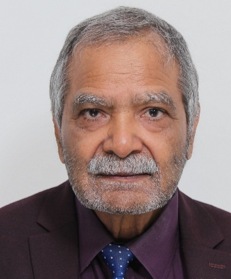
Shardhanand is the founder of Girmitiyalogy, Professor of Girmitiyalogy & Transcontinental Migration Studies, and was born on 17 September 1944 in Suriname into a humble agrarian Girmitiya family. He descended from Indian indentured laborers. His paternal grandfather, Kishun Dayal Singh, son of Harnandan Singh, migrated from Bihar Saran–Chapra, Chainwa Navda, to the Dutch colony of Surinam in 1896 in the colonial period. He arrived in Suriname in December 1896 under the indenture system. He could be repatriated after his girmit time.
As a young boy growing up in the rural district of Saramacca, Suriname, he dreamed of becoming a sea fisherman to follow in the footsteps of his father, Ramdath Harnandan Singh. Life, however, guided him toward a different destiny. Through education, perseverance, and public service, he developed into an educator, social change psychologist, author, and internationally recognized scholar of Transcontinental migration crossroads and the history and legacy of Indian indentured labor.
Today, he is regarded as one of the leading advocates for the restoration of ancestral bonds between India and the descendants of Indian indentured laborers worldwide.
Personal Details:
Nationality: Dutch
Naturality: Ethnic Sarnami Hindustani
Current Residence: Rotterdam, The Netherlands
Languages: Dutch, English, Portuguese, Sranan, Sarnami, Hindi, and Bhojpuri variant.
Educational Background:
Teacher Training College, Paramaribo, Suriname, 1966
Pedagogical Sciences, Rotterdam, The Netherlands, 1974
Social Change Management, University of Leiden, The Netherlands, 1984
Social and Preventive Psychiatry, Erasmus University Rotterdam, 1982
Continuing academic specialization in migration, multiculturalism, social cohesion, and identity formation.
Over a career span of more than six decades, Professor Singh has served in numerous professional capacities:
Teacher
School Principal
Educational Consultant
Educational Policy Adviser
Manager of the Welfare and Social Development Hindostani Community in the Netherlands.
Social Change Psychologist
Social Scientist
Ayurveda Practitioner
Columnist
Author
International Conference Speaker
Academic Program Developer
Professor of Girmitiyalogy & Transnational Migration Studies
His work has focused on education, multicultural societies, migration processes, social inclusion, intercultural relations, and sustainable citizenship.
Major Academic Contributions
Research Themes
Indian Indentured Labour Migration
Girmitiya Heritage Studies
Transcontinental Migration Processes
Hybrid and Diasporic Identities
Multicultural Societies
Social Cohesion and Nation Building
Restorative Justice for Descendants of Indentured Labourers
Decolonization of Archives
Intercultural Education
Vedic Perspectives on Society and Human Development
International Academic Activities
Shardhanand is internationally recognized as the founder of Girmitiyalogy, an interdisciplinary academic paradigm dedicated to the study of Indian indentured laborers (Girmitiyas), their descendants, archives, identities, cultures, migrations, and contemporary global communities.
He has participated in and helped organize numerous international conferences and academic initiatives involving institutions in India and Suriname
He has collaborated with scholars associated with institutions including:
Lucknow University
Jawaharlal Nehru University
Banaras Hindu University
Publications
Books
Ayurveda: Guide to a Healthy Diet in the Family (1998)
RSI Genezen met Ayurveda Therapie (2000)
Abandoned Past / Verlaten Verleden (2021)
Homogenization in Multiculturality (2024)
Loss of Sense: Verliesgevoelens in de Multiculturaliteit (2025)
Academic Papers
Processes in Transnational Migrations of Indian Indentured Servitudes
Indentureship as a Crime against Humanity
Plea for Restorative Justice for Global Indian Girmitiya Descendants
Girmitiyalogy: Origins, Mission, Vision and Global Collaborative Framework
Numerous scholarly essays on migration, multiculturality, identity, and archival justice.
Throughout his life, he has been actively involved in:
Educational reform
Integration and emancipation policies
Intercultural dialogue
Diaspora heritage preservation
Community development
Promotion of sustainable interethnic relations
International cooperation among Girmitiya descendant communities
His work has consistently emphasized the principle: “United in Diversity”, the Vedic ideal:
“Vasudhaiva Kutumbakam” — One Earth, One Family, One Future.
Singh’s lifelong mission is to reconnect descendants of Indian indentured laborers with their ancestral villages, promote scholarly research into their history and heritage, and contribute to more inclusive and harmonious multicultural societies. He pleads restorative justice for the Girmitiya diaspora as compensation for violence and dehumanization against the Girmitiyas and the international recognition of the Girmitya Pravasi Divas on the 10th of September every year.
Quote: From a young boy who dreamed of becoming a fisherman on the coast of the Atlantic Ocean in Suriname, he evolved into an educator, scholar, and global advocate for historical justice, cultural continuity, and human connectedness.
© 2026 Shardhanand H. Singh, Rotterdam