Author: Aartie Mahesh MSc
Amsterdam, September 25th, 2025
My search for insight and healing
Through the years I have gone through several personal paradigm shifts, including moving from business administration (my studies) to public administration (my profession). I have served democracy and the citizens of Amsterdam and has strongly advocated for the accessibility and availability of services and facilities for citizens. I am a proud descendant of girmitiyas and have always wondered whose shoulders I truly stand on. I also ask myself which talents and competencies I have inherited, passed down from my ancestors. And what intergenerational wounds and patterns still cause me to suffer today. What can I learn from all of this?
The Familysoul, Palwaar ke Dil
In finding my way in the Dutch society and manifesting myself, I have always looked for models and instruments that would help me to understand the situation, as well as finding my own strength for this purpose. Through my professional network, my attention has been drawn to the book De Familieziel by Kitlyn Tjin A Djie and Irene Zwaan. Kitlyn is a descendant of the Chinese community of the former Dutch colony of Indonesia. Working in Holland in the Dutch Youth Care System, she had experienced that in the Netherlands, the core family consists of a father, a mother and children (Tjin A Djie & Zwaan, 2013, p. 9).
When there was trouble, the child was removed from the family and placed into the system. To her, this was very odd. In her experience in Surinam, many factors influence a child’s upbringing. Such as the grandparents, aunties, uncles, neighbours, hand-picked families and so on. In the end, she has found a more enveloping model to approach family systems.
Furthermore, she has taken steps beyond that. She found out that every family has odd behaviours and patterns that family members (sub)consciously recognize (Tjin A Djie & Zwaan, 2013, p. 125). Not everything can be found in one’s character; it is to be found in the family history. She has described in her book techniques in oral history to uncover the behavior and patterns. So, you can look for solutions and healing.
More importantly, she has pointed out that migration is one of the severest events that take place in one’s life. She distinguished that on the whole, that every generation deals with this differently. The first generation, the first ones to live in a new place, find out and make it happen. The second generation portrays loyalty to this feat. And the third generation, on the contrary, is wondering why things go the way they go children (Tjin A Djie & Zwaan, 2013, p. 20 and 23). They question everything. In doing so, they provide oxygen to the family system. Very sadly though, this benefit has not been recognized in
various instances. In such cases, oral tradition techniques can also be helpful.
My starting position
Reflecting on the train of thought provided by Tjin A Djie and Zwaan in their book De Familieziel, I observe myself behaving like a member of the third generation. I question many things and have a strong need to understand and contribute to the greater good. For the Girmitiya Samaadj.
The first steps.
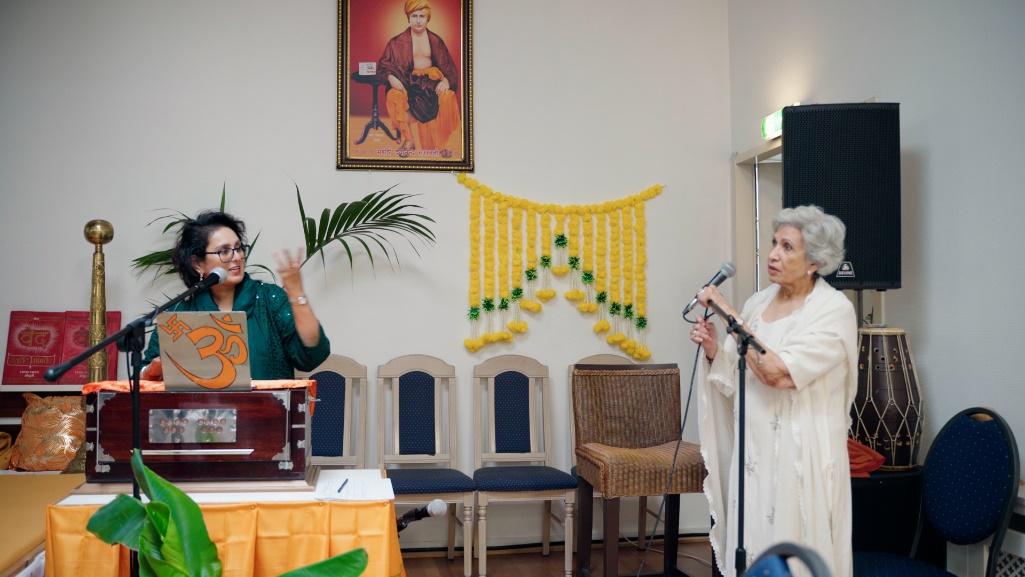
On the very first international meet and greet on Girmitiyalogy held July 5th 2025, in Zoetermeer, Netherlands, I started my search, conducting a short live interview. I interviewed my dear choti nanie (maternal grandmother).
In the Netherlands, there is a custom of giving nicknames to the many nanis, adjis, nanas, and adjas in order to distinguish them from one another. But we do not have (nick)names for great-aunts and great-uncles. Therefore, I invited my choti nanie to speak.
She is the daughter of a girmitiya and the youngest phoewa (paternal auntie) of my mother.
I had asked the following questions:
1. Dear choti nani, would you please introduce yourself? What is your name and where do you come from?
2. I have heard that your father crossed the ocean, the kala pani, twice. What can you tell us about that? Why twice?
3. What do you remember about your upbringing, your family life, and the values and norms you were given?
4. Which values and norms did your father explicitly teach you?
5. And which values, norms, customs, and habits did you learn or infer from the way your parents handled matters and situations?
The answers of my choti nani:
1. My name is Urmila Baldewpersad Tewarie. I come from Suriname; I was born in Nickerie.
2. My father crossed the kala pani twice. The first time, he came with my grandparents from India to the West Indies, first to Guyana. From Guyana they moved to Nickerie.
And from Nickerie to Paramaribo—not to the city itself, but to Kwatta. They stayed there for a few years. They had a very difficult time.
They wanted to do something with their lives: to work, to build a future. So, they returned to Nickerie to work in agriculture. That is what they did. When my father was about 17 years old, my grandparents went back with him to India. They stayed there for two or three years. My father could not adapt to the way
of life there; he was used to the freedom in Suriname and Guyana. That is why he left and came back via England. He stayed one or two years in England. He worked in London. He returned to Guyana, then moved to Nickerie, and later to Paramaribo.
There he married my mother. Two sons were born in Leiding, one of them being your nana, Aartie. Eventually, my parents returned to Nickerie. That is where the last five children were born, including myself.
The manners, customs, traditions, values, norms. First of all: learning Hindi. We had to wake up at five o’clock and learn Hindi from my father. He would tell us what to learn, what to write, and what to do. This took place before he performed his pooja. After he finished his pooja around six o’clock, he would tell us: ‘Okay, now you can do your homework in Dutch.’ My brother Hari was a bit lazy. When my father went to do his pooja, he would push two chairs together and go back to sleep. But he was caught.
We always had to be very polite. Never say just ‘ha,’ but ‘ji ha.’ And ‘ji na.’ Always answer with two words. I also learned how a girl was supposed to behave and how to speak with people. When we went to primary school, my father was no longer as strict with Hindi. Because he knew that we needed Dutch more than Hindi. So that was, in a way, a relief.
Important values are: being polite, knowing how to behave, as a woman, as a dignified human being. But as we grew up, we also became a little westernized. After completing MULO, I went to Paramaribo for further studies. There I lost some habits and traditions. I myself was not as strict with my children when they were growing up. I was more pragmatic. More western. Mastering Dutch properly was important.
Especially when we moved to the Netherlands.
In this short interview I have learnt new things my family. I didn’t expect this. This makes me
very enthusiastic learn more: techniques for oral traditions, more information about my
family.
To be continued.
Reference list:
• Tjin A Djie, K., & Zwaan, I. (2013). De familieziel: Hoe je geschiedenis je kan helpen
op je levenspad. Prometheus-Bert Bakker.
• Picture: kalapaniaacademia.com
About the author
Aartie Mahesh MSc was born in 1974 and raised in The Hague, the capital city of the Netherlands. She currently holds a Master’s Degree in Economics from the City of Amsterdam. She also studied Policy Studies at the Academy for Public Policy and Administration. She is married to Charles Soria and resides in the city of Amsterdam. She is employed by the Municipality of Amsterdam, where she works on social innovation initiatives aimed at improving quality of life in the city and strengthening democratic resilience.
Her maternal ancestors originate form Agra. Both of her parents were born and raised in Surinam. They migrated to the Netherlands, several years before the independence of the Republic of Surinam. In Surinam, her mother’s family, Baldewpersad Tewarie lived in District Nickerie, while her father’s family, Mahesh resided near 3Paramaribo, in District Kwatta. On arrival in Surinam, many surnames have been changed.
Some by the governmental administrators, some by the individuals themselves. Aartie’s surname Mahesh has been registered as a family name by the administrator, but is actually a first name in India. My mother’s family name is the combination first and family name of her grandfather. His name was Baldewpersad Tewarie.